

Editorial note: SciMoTech is an FDA-registered Class I medical device. This is the maximum FDA-related claim that can be made for SciMoTech. Terms like “FDA cleared” or “FDA approved” do not apply and must not be used. Some claims below reference published research on gait retraining as a treatment category, including research on AposTherapy, a related foot-worn gait-retraining product. That research provides general context for the category; it is not clinical evidence for SciMoTech specifically. SciMoTech’s own clinical data is internal, unpublished, and has not undergone peer review, and is not cited here. SciMoTech Therapy is a conservative care option for patients to explore, typically before a surgical decision, alongside guidance from their physician.
Walking is something most of us do without a second thought until it hurts. If every step brings a twinge, ache, or sharp pain, something is affecting how your joint handles the forces of walking.
Common Causes
- Osteoarthritis: cartilage wear that makes repetitive impact painful, especially after distance or stairs
- Meniscus damage: shock-absorbing cartilage tears that cause catching or instability under load
- Muscle weakness: weak quads or hips change how pressure moves through the knee
- Old injuries: past ACL tears or surgeries that quietly altered your movement mechanics
- Abnormal gait patterns: favoring one leg or shifting weight unevenly, concentrating force on part of the joint
- Bursitis or tendonitis: inflammation that flares with repetitive motion
- Post-surgical pain: lingering discomfort from movement habits surgery didn’t correct
What the Research Shows About Walking-Related Knee Pain
The forces moving through your knee during gait aren’t trivial. They’re a well-studied variable in OA research. A meta-analysis of gait retraining studies found that correcting walking mechanics produced statistically significant reductions in medial knee joint loading (the knee adduction moment) alongside meaningful improvements in the WOMAC pain and function index. In other words, how you walk is measurable, correctable, and clinically linked to how much your knee hurts.
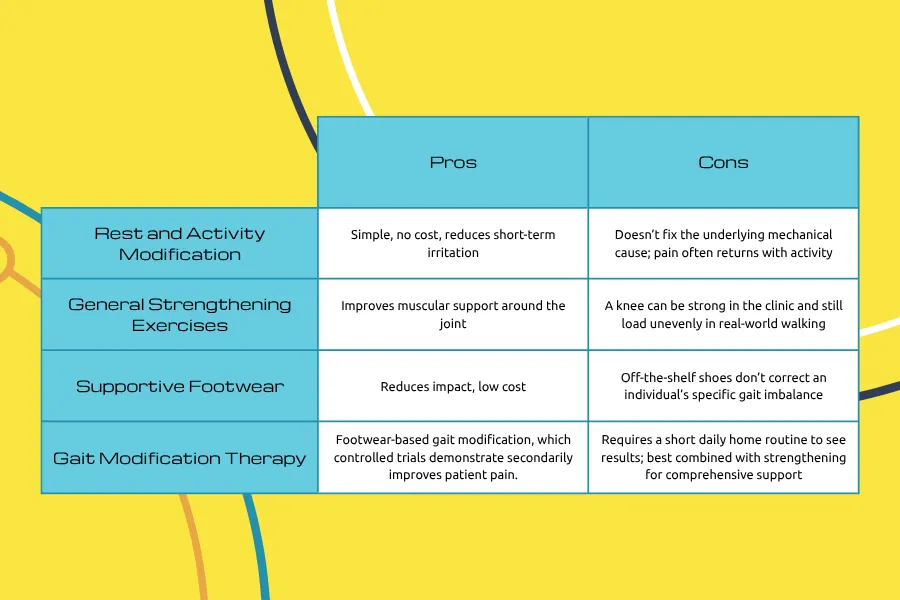
Comparing Ways to Address It
Rest and activity modification
Pros: Simple, no cost, reduces short-term irritation
Cons: Doesn’t fix the underlying mechanical cause; pain often returns with activity
General strengthening exercises
Pros: Improves muscular support around the joint
Cons: A knee can be strong in the clinic and still load unevenly in real-world walking
Supportive footwear
Pros: Reduces impact, low cost
Cons: Off-the-shelf shoes don’t correct an individual’s specific gait imbalance
Gait modification therapy
Pros: Directly targets the mechanical cause, uneven force distribution during walking, using motion capture and custom footwear-based technology. This is a gait modification and biomechanical loading approach. Controlled trials on gait retraining show reduced joint loading, with pain improvement reported by patients as a secondary observation.
Cons: Requires a short daily home routine (typically 15–30 minutes) to see results; best combined with strengthening for comprehensive support.
Why This Matters Beyond the Knee
Research on gait retraining as a treatment category, including published research on AposTherapy, a related foot-worn gait-retraining product, has looked at effects beyond the knee, including hip and lower back pain. This is included here as general context for the treatment category, not as clinical evidence for SciMoTech specifically. SciMoTech is an FDA-registered Class I medical device, and no joint-specific clinical outcomes are established or claimed for SciMoTech itself.
If you’ve been favoring one leg to avoid knee pain, that compensation doesn’t stay contained. It often adds strain to your hips, lower back, or the opposite knee. This is one reason gait-focused therapy is designed to look at the whole walking pattern rather than just the joint that originally hurt, addressing biomechanical stress across the chain, not just one point.

When to See a Doctor
See a doctor if pain wakes you at night, your knee feels unstable, swelling doesn’t resolve, or symptoms are steadily worsening.
Take the Next Step
If walking-related knee pain has been resistant to rest, exercise, or medication, your gait itself may be a contributing factor worth assessing. Book an initial consultation for a personalized motion assessment and see how your gait may be contributing to your symptoms, and whether gait modification therapy could help.
This article is for general educational purposes and is not a substitute for medical advice.
Sources: Effectiveness of gait retraining interventions systematic review/meta-analysis, Gait & Posture, 2022; Shull et al., Journal of Orthopaedic Research, 2013. Bar-Ziv et al., BMC Musculoskeletal Disorders, 2010; Bar-Ziv et al., Arthritis, 2013 (AposTherapy research, cited as category context only, not as SciMoTech-specific clinical evidence).