

Editorial note: SciMoTech is an FDA-registered Class I medical device. This is the maximum FDA-related claim that can be made for SciMoTech — terms like “FDA cleared” or “FDA approved” do not apply and must not be used. Some claims below reference published research on gait retraining as a treatment category, including research on AposTherapy, a related foot-worn gait-retraining product. That research provides general context for the category; it is not clinical evidence for SciMoTech specifically. SciMoTech’s own clinical data is internal, unpublished, and has not undergone peer review, and is not cited here. SciMoTech Therapy is a conservative care option for patients to explore, typically before a surgical decision, alongside guidance from their physician.
When people think about knee pain, they focus on the joint itself. But there’s a factor that’s just as important and often overlooked: your gait, or the way you walk.
Why Gait Matters for Knee Health
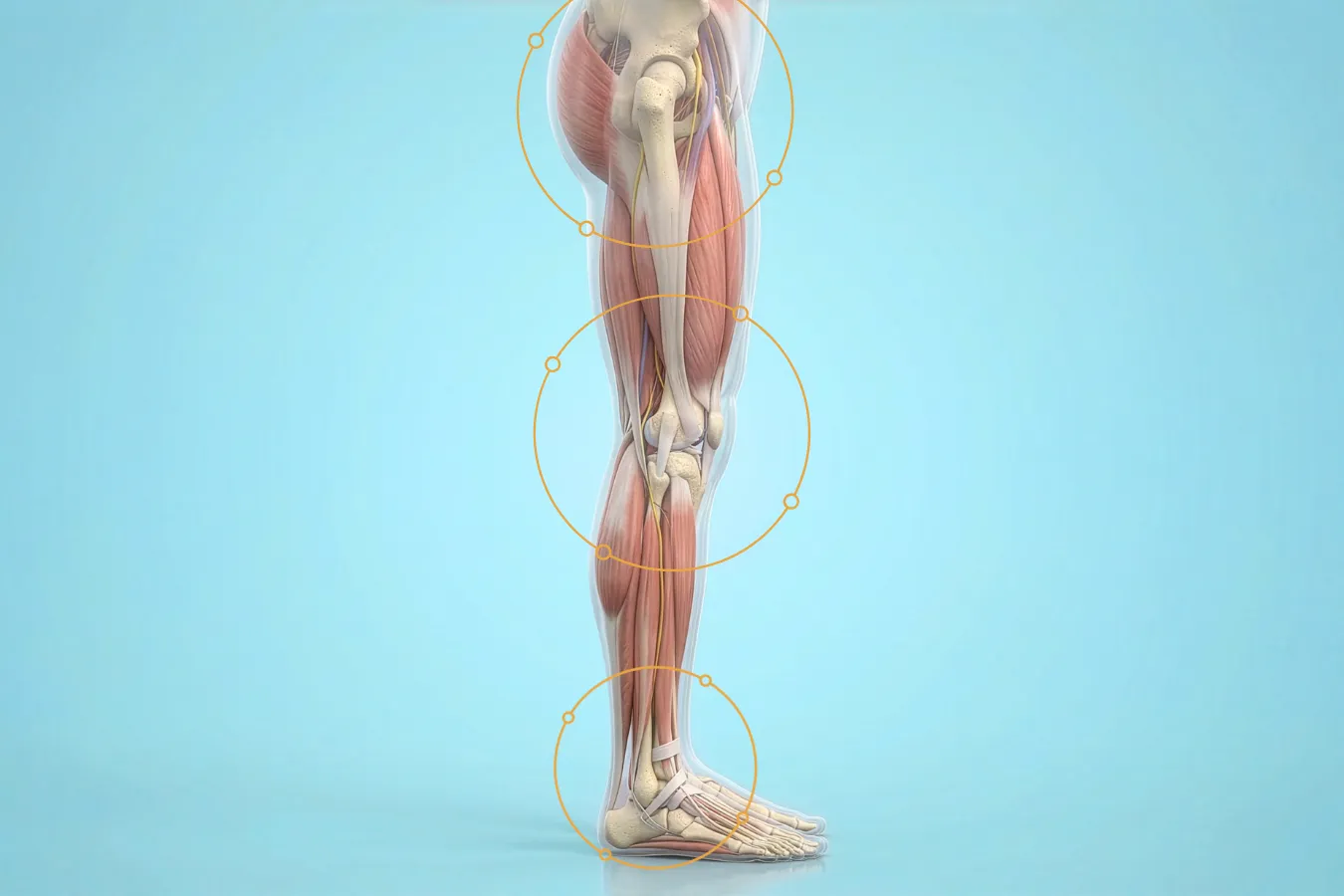
Every step sends force up through your foot, ankle, knee, hip, and spine. When gait is balanced, that force distributes evenly. When it shifts — from pain, an old injury, or muscle weakness — force can concentrate unevenly, most often on the inner (medial) side of the knee, which is affected roughly ten times more often than the outer side in knee OA.
What the Research Says
This isn’t a fringe idea. It’s an active area of orthopedic research in the US and internationally. A landmark six-week gait retraining trial found that correcting gait reduced medial knee joint loading and improved both pain and function, with those improvements holding a month after training ended.
A more recent systematic review and meta-analysis pooled multiple controlled studies and found statistically significant reductions in joint loading and meaningful improvement in patient-reported pain and function scores when gait retraining was compared with control interventions.
Common Causes of Gait Imbalance
- Pain avoidance (unconsciously shifting weight off a sore knee)
- Old injuries or past surgeries
- Muscle weakness, especially in the hips
- Arthritis-related pain and stiffness
- Leg length discrepancies
Comparing How Gait Imbalance Is Typically Addressed
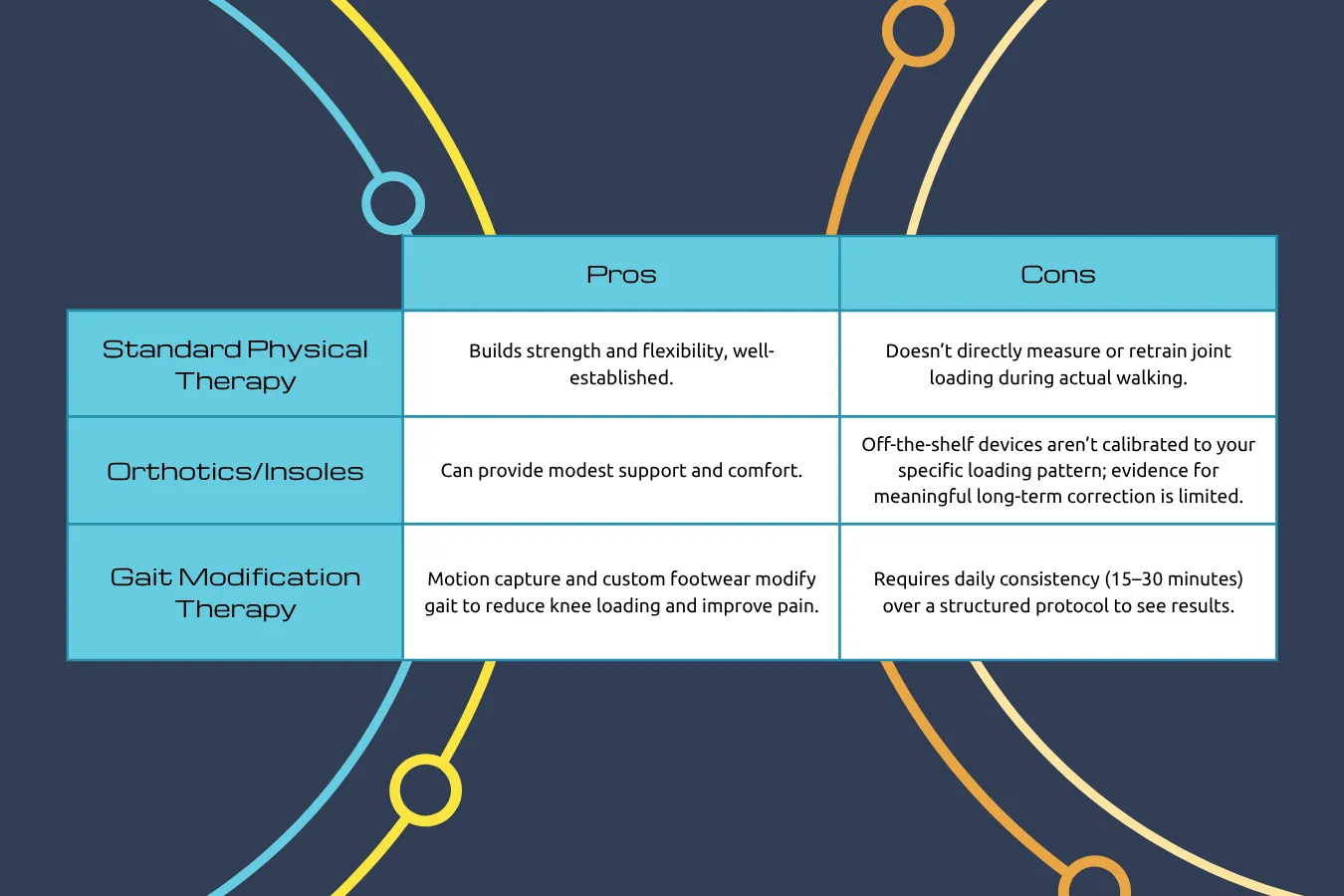
Standard physical therapy
Pros: Builds strength and flexibility, well-established
Cons: Doesn’t directly measure or retrain joint loading during actual walking
Orthotics/insoles
Pros: Can provide modest support and comfort
Cons:Off-the-shelf devices aren’t calibrated to your specific loading pattern; evidence for meaningful long-term correction is limited
Gait modification therapy
Pros: Uses motion capture to precisely measure your walking pattern, then applies custom footwear-based technology to actively retrain it — a gait modification and biomechanical loading approach. This is the approach with the strongest direct evidence for reducing knee joint loading specifically, particularly relevant to osteoarthritis and patellofemoral joint (PFJ) pain, with pain improvement noted in research as a secondary, patient-reported outcome
Cons: Requires daily consistency (15–30 minutes) over a structured protocol to see results
How Gait Is Assessed
Clinicians use motion capture technology and clinical assessment to evaluate how you walk in real time, measuring stride, weight distribution, and joint loading. This captures information a static exam simply can’t.
Beyond the Knee: A Whole-Chain Problem
Research on gait retraining as a treatment category, including published research on AposTherapy, a related foot-worn gait-retraining product, has looked at effects beyond the knee, including hip and lower back pain. This is included here as general context for the treatment category, not as clinical evidence for SciMoTech specifically. SciMoTech is an FDA-registered Class I medical device, and no joint-specific clinical outcomes are established or claimed for SciMoTech itself.
An imbalanced gait rarely stays contained to one joint. Uneven loading patterns are frequently linked to compensatory pain in the hips, lower back, and the opposite knee. Because gait modification therapy retrains the entire walking pattern, not just how the affected knee moves, it’s designed to address the same biomechanical root cause across multiple joints, not just the one that hurts most.
The Bottom Line
Your knee doesn’t operate in isolation. It’s part of a chain of movement that starts with every step. If knee pain has resisted typical treatment, it may be time to have your gait specifically evaluated.
See Your Gait for Yourself
Book your initial consultation for a motion capture assessment and see how your walking pattern may be contributing to your knee pain, and what a custom gait modification protocol could offer.
This article is for general educational purposes and is not a substitute for medical advice.
Sources: Shull et al., Journal of Orthopaedic Research, 2013; gait retraining systematic review/meta-analysis, Gait & Posture, 2022. Bar-Ziv et al., BMC Musculoskeletal Disorders, 2010; Bar-Ziv et al., Arthritis, 2013 (AposTherapy research, cited as category context only, not as SciMoTech-specific clinical evidence).