
Editorial note: SciMoTech is an FDA-registered Class I medical device. This is the maximum FDA-related claim that can be made for SciMoTech — terms like “FDA cleared” or “FDA approved” do not apply and must not be used. Some claims below reference published research on gait retraining as a treatment category, including research on AposTherapy, a related foot-worn gait-retraining product. That research provides general context for the category; it is not clinical evidence for SciMoTech specifically. SciMoTech’s own clinical data is internal, unpublished, and has not undergone peer review, and is not cited here. SciMoTech Therapy is a conservative care option for patients to explore, typically before a surgical decision, alongside guidance from their physician.
A knee pain diagnosis doesn’t automatically mean surgery is next. Most professional guidelines, including those from rheumatology and orthopedic bodies, recommend conservative care as the first step. Here’s an honest look at your options — including where the evidence is strong and where it’s weaker.
7 Non-Surgical Treatment Options for Knee Pain
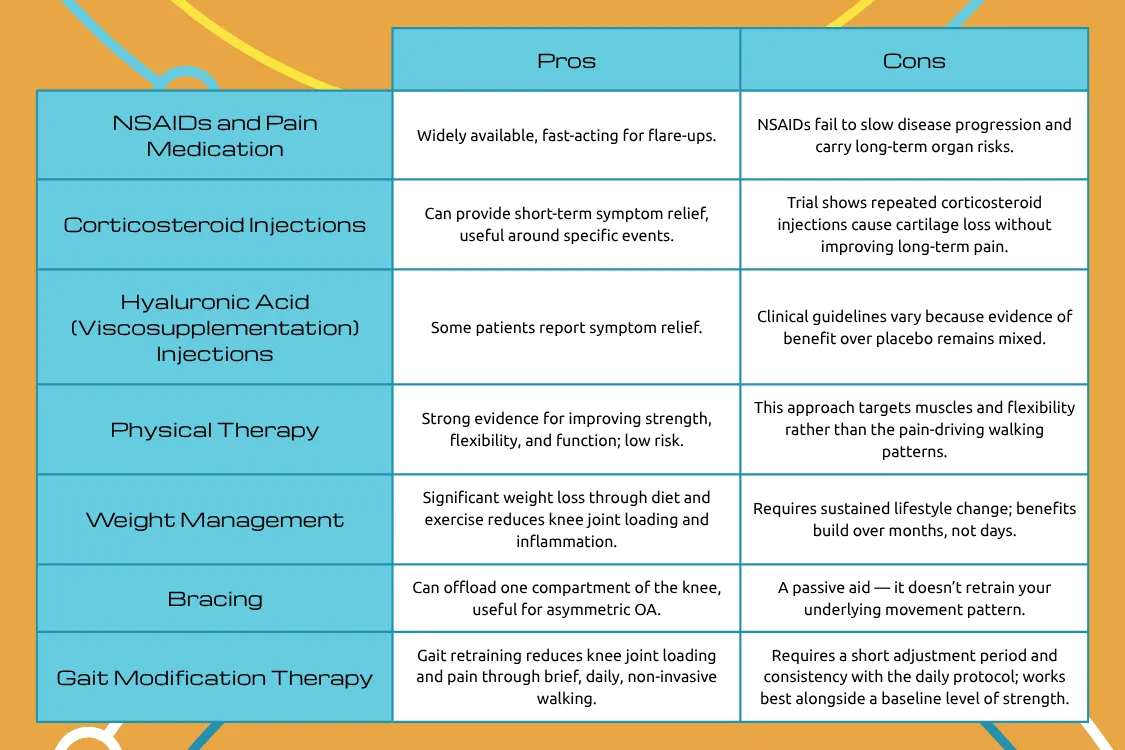
1. NSAIDs and Pain Medication
Pros: Widely available, fast-acting for flare-ups
Cons: Doesn’t slow disease progression or correct the mechanical cause; long-term use carries GI, kidney, and cardiovascular risks
2. Corticosteroid Injections
Pros: Can provide short-term symptom relief, useful around specific events
Cons: A randomized trial published in JAMA found that injections given every three months over two years led to significantly greater cartilage volume loss compared with placebo, with no significant difference in pain outcomes; injections remain standard, widely used care, and this reflects one specific protocol, not all corticosteroid use
3. Hyaluronic Acid (Viscosupplementation) Injections
Pros: Some patients report symptom relief
Cons: Evidence for meaningful benefit over placebo is mixed, and major clinical guidelines vary in whether they recommend it
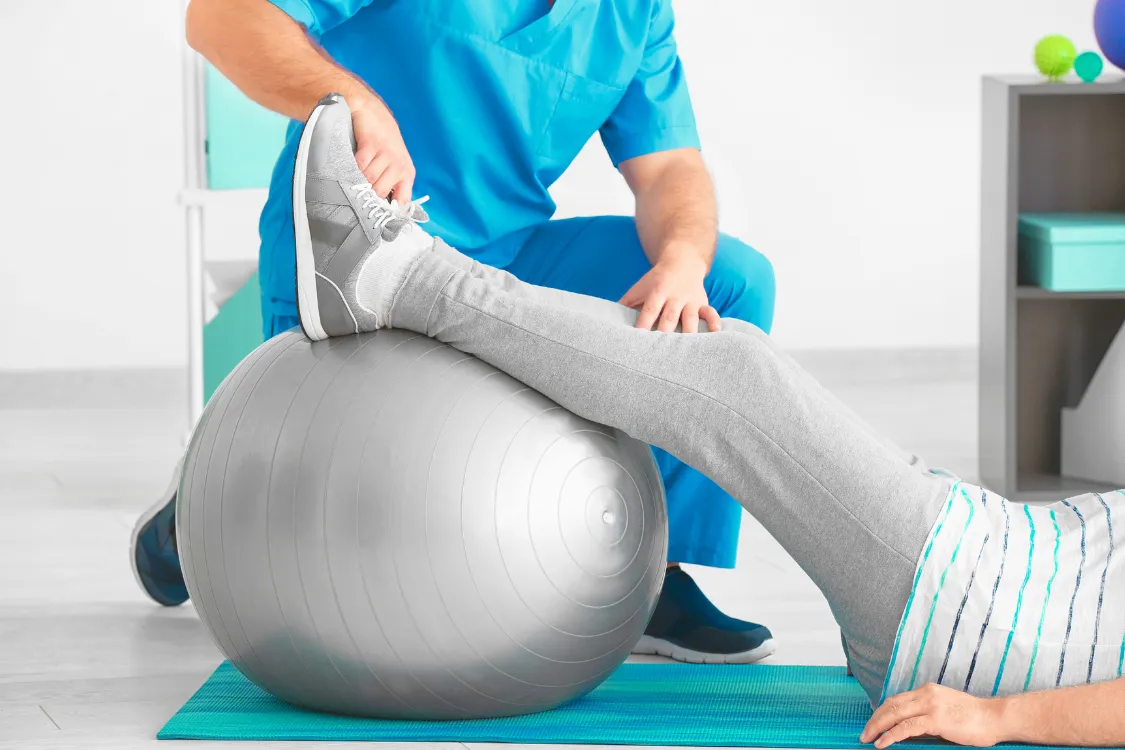
4. Physical Therapy
Pros: Strong evidence for improving strength, flexibility, and function; low risk
Cons: Targets muscles and range of motion, not necessarily the specific loading pattern that drives pain during walking
5. Weight Management
Pros: The IDEA trial (JAMA, 2013) found that a ≥10% reduction in body weight through diet, especially combined with exercise, meaningfully reduced knee joint loads, inflammation markers, and clinical symptoms
Cons: Requires sustained lifestyle change; benefits build over months, not days
6. Bracing
Pros: Can offload one compartment of the knee, useful for asymmetric OA
Cons: A passive aid — it doesn’t retrain your underlying movement pattern
7. Gait Modification Therapy
Pros: A gait modification and biomechanical loading approach that directly targets uneven joint loading — the mechanical driver behind much of OA and patellofemoral joint (PFJ) pain. A systematic review and meta-analysis of gait retraining found significant reductions in medial knee joint loading, with WOMAC pain/function index improvements reported as a secondary, patient-reported observation. It’s non-invasive, drug-free, and typically requires just 15–30 minutes of daily walking at home.
Cons: Requires a short adjustment period and consistency with the daily protocol; works best alongside a baseline level of strength
Who Gait Modification Therapy May Not Be Right For
To keep this comparison balanced: gait modification therapy isn’t the right starting point for everyone. It’s generally not appropriate as a stand-alone treatment for acute injuries, joint instability requiring urgent surgical evaluation, uncontrolled neuromuscular or balance conditions, or knees with mechanical locking. Patients in these situations should be evaluated by a physician first. Like any therapy, individual results vary, and a clinician should confirm it’s an appropriate fit before starting.
Why Gait Modification Therapy Is a Strong Option for OA and PFJ Pain
Of all the non-surgical options above, gait modification therapy is the only one specifically designed to correct where and how force loads your knee joint — the mechanical root of both osteoarthritis progression and patellofemoral joint pain. Medication and injections manage symptoms; physical therapy builds capacity; but neither directly retrains the loading pattern the way gait-focused therapy does. This is why SciMoTech Therapy uses motion capture and custom, footwear-based technology calibrated to your individual biomechanics — to change how you move, not just how you feel in the short term.
A Whole-Body Approach
Research on gait retraining as a treatment category — including published research on AposTherapy, a related foot-worn gait-retraining product — has looked at effects beyond the knee, including hip and lower back pain. This is included here as general context for the treatment category, not as clinical evidence for SciMoTech specifically. SciMoTech is an FDA-registered Class I medical device, and no joint-specific clinical outcomes are established or claimed for SciMoTech itself.
Knee pain rarely stays isolated. Many patients who alter their gait to protect a painful knee end up with secondary hip, lower back, or opposite-knee pain from the compensation. Because gait modification therapy addresses your overall walking pattern, it’s often able to support relief across multiple joints affected by the same underlying biomechanical imbalance — not just the one that first started hurting.
Building Your Plan
Most patients do best combining approaches — for example, physical therapy for strength alongside gait modification therapy for joint loading, plus reasonable weight management. A clinician can help you sequence this based on your specific diagnosis.
Ready to See What’s Right for You?
The best way to know which combination of treatments fits your knee is a personalized assessment. Book your initial consultation to get a gait analysis and discuss your goals and options with a clinician.
This article is for general educational purposes and is not a substitute for medical advice.
Sources: McAlindon et al., JAMA, 2017; Messier et al., JAMA, 2013 (IDEA Trial); gait retraining systematic review/meta-analysis, Gait & Posture, 2022. Bar-Ziv et al., BMC Musculoskeletal Disorders, 2010; Bar-Ziv et al., Arthritis, 2013 (AposTherapy research, cited as category context only, not as SciMoTech-specific clinical evidence).